Rule-Based Chatbot or AI Chatbot: A Simple Guide for Indian Businesses
Many businesses want a chatbot on WhatsApp or their website but are not sure which kind to build. This guide compares simple menu bots with AI chatbots in plain words, so you can pick the one that fits your customers, team and budget.
What is the difference between a rule-based chatbot and an AI chatbot?
In the rule-based chatbot vs AI chatbot choice, a rule-based bot follows fixed menus and buttons that you design, so it gives the same answer every time. An AI chatbot uses a large language model to understand free text and reply in natural language. Rule-based bots are simpler and predictable. AI bots handle open questions better.
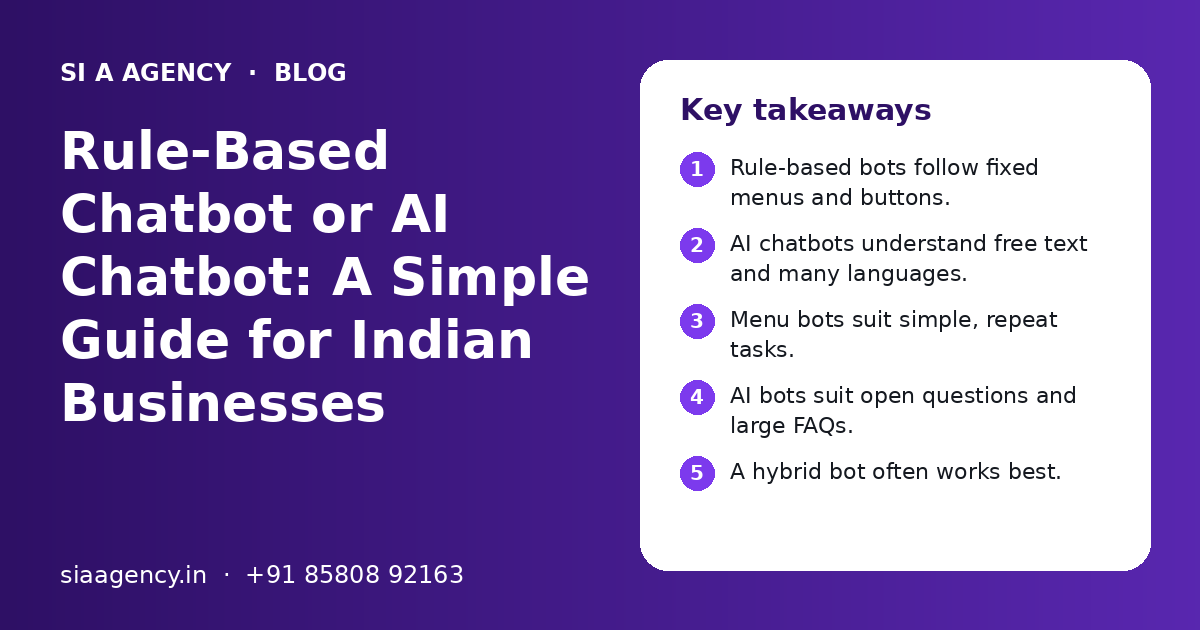
Key takeaways
- Rule-based bots follow fixed menus and buttons.
- AI chatbots understand free text and many languages.
- Menu bots suit simple, repeat tasks.
- AI bots suit open questions and large FAQs.
- A hybrid bot often works best.
- Always add a handover to a real person.
What is the difference between a rule-based chatbot and an AI chatbot?
The main difference in the rule-based chatbot vs AI chatbot question is how the bot decides what to say. A rule-based bot follows a path you draw in advance, while an AI chatbot reads the message and writes a reply based on the information you give it.
Think of a rule-based bot as an IVR menu in chat form: press 1 for prices, press 2 for timings. An AI chatbot is closer to a trained front-desk person who can understand a question even if it is asked in a new way.
Both types can run on WhatsApp, on your website, on Instagram DMs or inside an app. The channel does not decide the type. The logic behind the bot does. Our AI chatbot development page explains how we build both.
How do rule-based and AI chatbots compare side by side?
Rule-based bots win on predictability and simple setup, while AI chatbots win on flexibility and handling real, messy questions. The table below shows the main points.
| Point | Rule-based chatbot | AI chatbot |
|---|---|---|
| How it works | Fixed menus, buttons and keywords | Understands free text using an LLM |
| Answers | Same answer every time | Writes a fresh reply each time |
| Free-text questions | Weak, often says 'please choose an option' | Strong, understands many ways of asking |
| Languages | Each language needs its own flow | Can understand and reply in Hindi, Hinglish and other languages |
| Setup work | Design every path by hand | Prepare data, rules and testing |
| Risk of wrong answers | Very low, only says what you wrote | Possible, needs limits and testing |
| Running cost factors | Platform and message charges | Platform, message and AI model usage charges |
| Updates | Edit flows when anything changes | Update the knowledge base documents |
| Best for | Simple, repeat tasks | Open questions and large FAQs |
When does a rule-based chatbot fit best?
A rule-based chatbot fits best when customers mostly want the same few things and the answers rarely change. It is also right when every answer must be exact, with no room for creative wording.
- Showing store timings, address and a Google Maps link.
- Sharing a fixed brochure, menu card or catalogue PDF.
- Collecting name, city and requirement before a callback.
- Order status lookup with an order number.
- Booking a slot from a fixed list of dates and times.
- Payment reminders with a UPI link or invoice.
For example, a coaching centre may only need four buttons: courses, fees enquiry, batch timings and talk to a counsellor. A menu bot does this well. It is quick to build and easy for staff to understand.
Strengths of rule-based bots
- Predictable, exact answers
- Simple to test, since every path is known
- Lower running cost factors
- Easy for users who prefer tapping buttons
Limits of rule-based bots
- Fails when users type their own questions
- Long menus frustrate users
- Every new topic needs a new flow
- Feels robotic for complex queries
When does an AI chatbot fit best?
An AI chatbot fits best when customers ask many different questions in their own words, or when you have a large set of information that is hard to fit into menus.
Indian customers often type in mixed languages, such as Hinglish, and use short forms. They may ask two questions in one message. A menu bot struggles with this. An AI chatbot can usually understand the intent and reply properly.
- Clinics answering questions about doctors, timings, tests and preparation steps.
- Online stores answering questions about sizes, materials, delivery and returns.
- Real estate firms explaining projects, locations, sizes and site visit steps.
- Schools and institutes answering admission, course and document questions.
- Companies with long product manuals or policy documents.
The quality of an AI chatbot depends on the data you give it. Most business bots use a method called RAG, where the bot first searches your approved documents and then answers only from them. Our page on the RAG knowledge base chatbot explains how this works.
Strengths of AI chatbots
- Understands free text and mixed languages
- Handles many topics without long menus
- Feels more natural to customers
- Easier to update by changing documents
Limits of AI chatbots
- Can give a wrong answer without proper limits
- Needs careful testing before launch
- Model usage adds to running costs
- Needs clean, current business data
What is a hybrid chatbot, and why do many businesses choose it?
A hybrid chatbot combines buttons for common, fixed tasks with AI for open questions. Many businesses choose it because it gives exact answers where needed and flexible answers everywhere else.
In a hybrid bot, the customer first sees a short menu. If they tap a button, the fixed flow runs. If they type their own question, the AI part takes over and answers from your approved data. Sensitive steps, like payments or bookings, still follow fixed rules.
- 1
List the top questions
Collect real questions from WhatsApp chats, calls and emails from the last few months.
- 2
Split them into two groups
Put fixed, exact tasks (timings, booking, order status, payment links) in the menu group. Put open questions in the AI group.
- 3
Build menu flows first
Create short button flows for the fixed tasks. Keep menus to a few options each.
- 4
Prepare the AI knowledge base
Write clear, current answers for open topics, and remove old prices and policies.
- 5
Set handover rules
Decide when the chat must pass to a person, such as complaints, refunds or angry customers.
- 6
Test and launch slowly
Test with staff and a small group of customers, fix weak answers, then go live for everyone.
This approach works well on WhatsApp, where customers like quick buttons but also type freely. See our AI WhatsApp chatbot page for how we set this up.
How do WhatsApp and website chatbots differ in practice?
WhatsApp chatbots work inside a channel customers already use every day, while website chatbots help visitors who are already looking at your products or services. Both can be rule-based, AI or hybrid.
| Point | WhatsApp chatbot | Website chatbot |
|---|---|---|
| Where users come from | Ads, QR codes, saved number, website button | Google search, ads, social links |
| Buttons and lists | Supported through the WhatsApp Business Platform | Fully flexible design |
| Message rules | WhatsApp policies and template approval apply | Your own rules |
| Follow-up | Can send approved template messages later | Visitor may leave and not return |
| Best use | Enquiries, bookings, reminders, order updates | Product help, lead capture, FAQs |
For WhatsApp, a business usually needs the WhatsApp Business Platform (API) through Meta or an approved provider. Meta's official business site at business.whatsapp.com has the current rules. A plain WhatsApp Business app on a phone has only basic auto-replies.
How do you keep an AI chatbot safe and accurate?
You keep an AI chatbot safe by limiting what it can talk about, giving it only approved data, adding a clear handover to people and testing it with real questions before launch.
A rule-based bot can only say what you wrote. An AI chatbot writes its own sentences, so it needs guard rails. Without them, it may guess an answer, mention a wrong price or go off topic.
- Answer only from approved documents, and say 'I am not sure' when the answer is missing.
- Keep fixed tasks like payments, bookings and refunds in rule-based flows.
- Do not let the bot give medical, legal or financial advice.
- Never put passwords, API keys or private customer data in the knowledge base.
- Ask for consent before collecting personal details, and collect only what you need.
- Hand over to a person for complaints and sensitive cases.
- Review chat logs every week in the first months and fix weak answers.
Our AI agent security and safety page covers these controls in more detail. They apply to chatbots as well as to AI agents.
What affects the cost of a rule-based chatbot vs an AI chatbot?
The cost of both types depends on the number of flows or topics, the channels, the integrations and the monthly message volume. AI chatbots add model usage charges and more testing work.
| Cost factor | Rule-based chatbot | AI chatbot |
|---|---|---|
| Design work | Number of menus and paths | Number of topics and rules |
| Data preparation | Little, answers are written in flows | Cleaning and organising documents |
| Integrations | CRM, sheets, booking or payment links | Same, plus the AI model connection |
| Platform charges | Chatbot tool or WhatsApp provider | Chatbot tool or WhatsApp provider |
| Message charges | WhatsApp conversation charges by Meta | WhatsApp conversation charges by Meta |
| Model usage | None | Charged by the AI provider based on usage |
| Testing and upkeep | Edit flows when things change | Review logs, update data, retest |
If you connect the bot to your CRM, lead details flow straight to your sales team. Our AI CRM integration page explains this. For a wider view of AI build costs, read what affects AI agent development cost. You get a clear quote after a free call.
How do you choose between a rule-based and an AI chatbot?
Choose by looking at your real customer questions. If most can be answered by a few buttons, start rule-based. If customers type many different questions, choose AI or hybrid.
| If this is true for you | Start with |
|---|---|
| Fewer than a handful of common questions | Rule-based |
| Answers must be exact every time, with no variation | Rule-based |
| Customers type long questions in mixed languages | AI chatbot |
| You have large FAQs, manuals or product catalogues | AI chatbot |
| You need both fixed bookings and open questions | Hybrid |
| You are unsure and want to start small | Rule-based first, add AI later |
SI A Agency is powered by Shivah Web Tech, with 11+ years of experience and 500+ projects. We usually start by reading your past chats and calls, then suggest the simplest bot that solves the problem. If customer support is your main goal, see our AI customer support page, or contact us for a free call.
Frequently Asked Questions
Is a rule-based chatbot or an AI chatbot better for a small business?
It depends on the questions your customers ask. If most people want the same few things, like timings, prices or booking, a rule-based bot is simpler and predictable. If customers type many different questions in their own words, an AI chatbot or a hybrid bot will serve them better. Many small businesses start simple and add AI later.
Can a rule-based chatbot work on WhatsApp?
Yes. Using the WhatsApp Business Platform, a bot can show reply buttons and list menus. Customers tap an option and the bot shows the next step. This works well for enquiries, bookings, order status and payment reminders. For free-text questions, you can add an AI layer on top of the menu.
Do AI chatbots give wrong answers?
They can if they are not set up carefully. An AI chatbot may guess when it does not have the right information. You reduce this risk by giving it only approved data, telling it to admit when it does not know, keeping sensitive tasks in fixed flows and testing it with real questions before and after launch.
Can an AI chatbot reply in Hindi and other Indian languages?
Modern AI models can understand and reply in Hindi, Hinglish and many other Indian languages. Quality can vary by language, so test the bot with real customer messages in each language you need. A rule-based bot can also support many languages, but each language usually needs its own set of menus and replies.
What is a hybrid chatbot?
A hybrid chatbot mixes buttons and AI. Fixed tasks such as bookings, order status and payment links run through menu flows, so answers stay exact. Open questions typed by customers go to the AI part, which answers from your approved data. It also hands the chat to a person when needed.
Can I upgrade my existing rule-based chatbot to AI?
Usually yes. You can keep your current menus and add an AI layer for questions that do not match any button. This needs a clean knowledge base, clear rules on what the AI may answer and testing. Upgrading step by step is often safer than replacing the whole bot at once.
Is an AI chatbot more expensive to run than a rule-based one?
An AI chatbot usually has an extra running cost for model usage, charged by the AI provider based on how much it is used. It also needs more setup and testing. Both types share platform and WhatsApp message charges. The total depends on chat volume, channels and integrations, so a quote after a short call is the clearest way to know.
Talk to our team today
Call or WhatsApp +91 85808 92163. We reply fast, Monday to Friday.